


Now Available: Download the 2027 Multiple Choice Look Book Now
The 2026 Multiple Choice Look Book Is Now Available to Download
The 2026 Multiple Choice Look Book is now available to download, offering a window into the organizations, ideas, and impact already expanding what is possible for K–12 education. Featuring 2026 Multiple Choice partners, the Look Book highlights the growing ecosystem working toward a more dynamic, learner-centered K–12 education system.
See the Multiple Choice Community in Action
K–12 education is becoming more dynamic, personalized, and expansive. Across the country, new models are taking shape, existing systems are evolving, and parents, students, and educators have more opportunities to imagine what a high-quality education can look like.
Multiple Choice at ASU+GSV brings this growing community together under one BIG TENT: from public schools and districts, charters, and private schools to states, philanthropies, investors, and EdTechs — plus new models like microschools, virtual schools, homeschools, and hybrid schools.
The organizations featured in the Look Book bring that ecosystem to life. Together, they are reaching millions of students and families, launching and supporting new schools and learning models, giving families more choices, supporting educators, advancing policy, and building the technology and infrastructure that make those choices possible.
The work takes many different forms, but it is moving toward the same goal: a more dynamic, learner-centered K–12 education system.
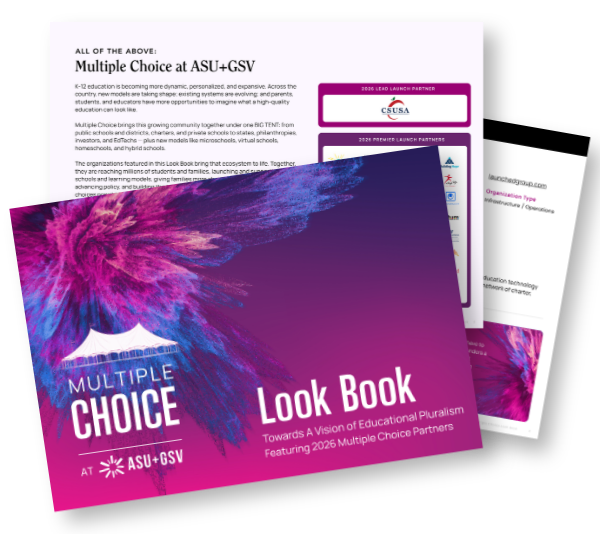
Organizations featured in the 2026 Multiple Choice Look Book
The 2026 Look Book features:
- CSUSA: LaunchEd
- Center for Education Reform
- EdChoice
- Stand Together Trust
- Building Hope Impact Fund
- FlexPoint
- Odyssey
- Step Up For Students
- America Achieves
- ASU Preparatory Academy
- Big Picture Learning
- E.L. Haynes Public Charter School
- Ednovate Charter Schools
- Getting Smart
- KaiPod Learning
- Johns Hopkins University Institute for Education Policy
- LEAP Innovations
- National Microschooling Center
- North Shore School District 112
- Paloma Learning
- SchoolMint
- Transcend
Towards a Vision of Educational Pluralism
Multiple Choice is grounded in the belief that ALL students deserve equal access to a high-quality education and a bright future. Getting there means creating more options for families, more opportunities to personalize learning, and strong accountability for what works — so that more students can find the education that works for them.
At a defining moment for students in the age of AI, no single model or institution has all the answers. Progress will require experimentation, accountability, collaboration, and iteration rooted in outcomes.
Explore the 2026 Multiple Choice Look Book and meet the organizations helping expand what is possible for K–12 education.


.svg)


