

Spotlight on Innovation: Peninsula School District
At ASU+GSV, we believe the most powerful ideas come from the leaders on the front lines. We want to lift up K-12 leaders' stories of impact, innovation, and lasting change from the field to share with our global community—so we've asked visionary superintendents about how they're approaching systemic innovation with both ambition and purpose.
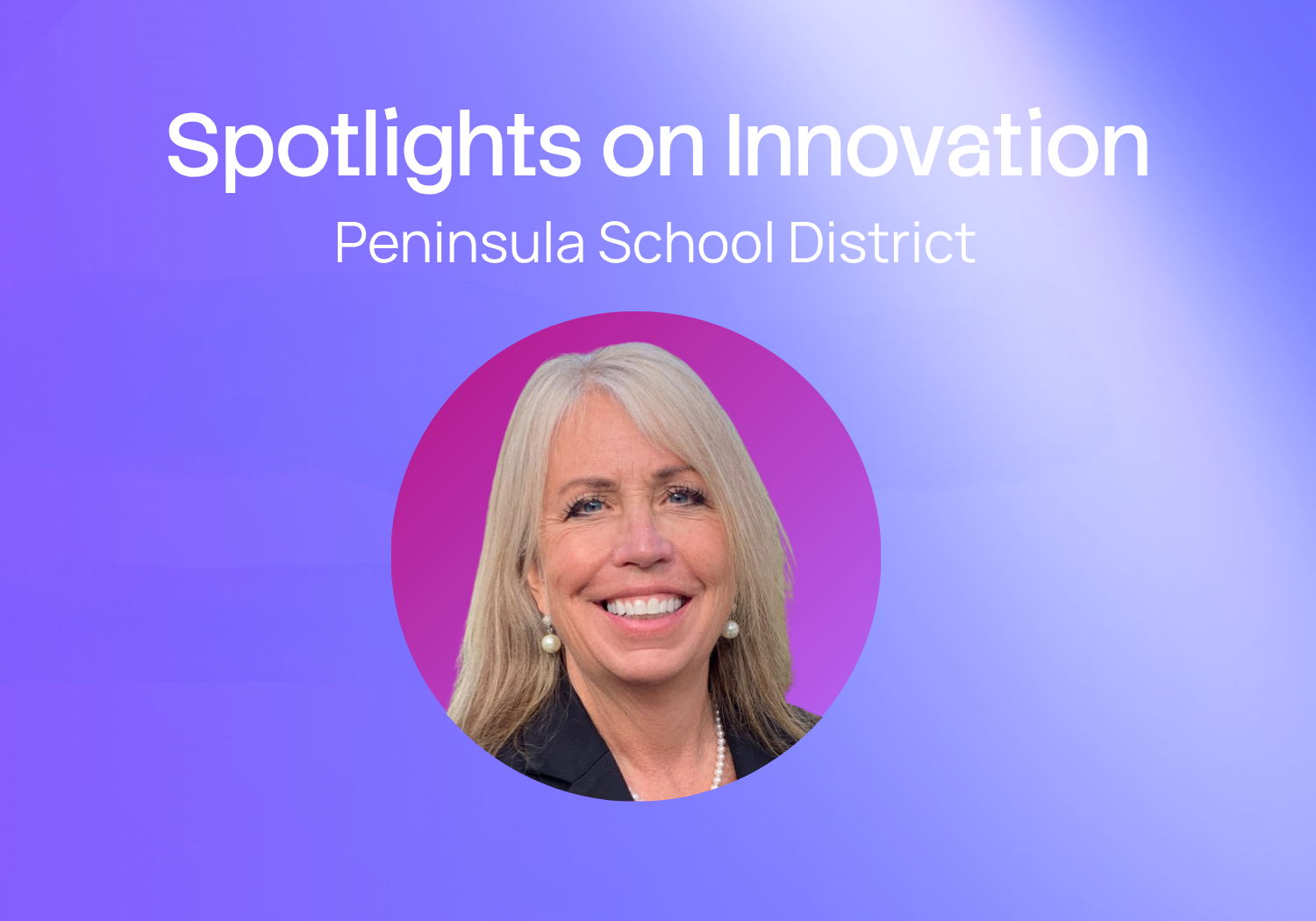
Krestin Bahr, Superintendent of Peninsula School District in Gig Harbor, WA, is pioneering The Open Adaptive District, an agility protocol that balances experimentation and rigor while piloting and scaling new technologies. Here's what she had to say about leading systemic innovation:
Q: How do we turn what's working in our schools into lasting change by moving from isolated pilots to scaled impact?
AI may be education’s Sputnik moment. The pace of change is creating extraordinary disequilibrium and an opportunity to rethink school systems. Our moonshot is to build a district capable of learning and adapting as rapidly as the world our children will inherit.
Through our Google Fellowship & Open Adaptive District, teams tackle real problems in six-week cycles, revise their approaches and share what they learn. AI helps connect that learning; promising solutions become tools others can use and improve. Lasting change happens when innovation becomes a shared capability that outlives a pilot.
Q: How do we create space for educators to try, learn and improve without the fear of getting it wrong?
As a former science teacher, I know discovery requires questions, evidence, and a willingness to find out we were wrong. As superintendent, my responsibility is to create those conditions for adults too. We give teams room to test ideas, adjust, and stop an approach that does not work. Failure must be an option within clear safeguards: protect students, preserve privacy, and keep human judgment central. An unsuccessful experiment can still move us forward when its learning is shared.
We cannot ask educators to help shape the future while expecting them to get everything right the first time.
Q: Do you have any recommended resources, articles, or case studies related to systemic innovation?
- "Building the Open Adaptive District: What We're Doing and Why It Matters for Public Education": Superintendent Krestin Bahr on what Peninsula School District is building through the Open Adaptive District, and why schools need a voice in how AI is built.
- "The Open Adaptive District — Start Here": We wrote this for two readers: Peninsula School District staff on a team this year, and other districts that want to run the same protocol. Everything here is free to copy and adapt. Where we name a Peninsula tool, a note says what you would need in its place.
- "Breaking Down Language Barriers: How AI Can Give Every Student a Voice": Karen Kennedy Floyd, Gig Harbor High School English Teacher shares how the use of HeyGen has given one of her students a voice she has not been able to show.